Wednesday, April 18, 2007

Convergence and Romantic Misdiagnosis


Romantic Misdiagnosis, originally uploaded by The River Thief. Collage copyright Ruth Seeley; photo copyright James Nash.

It is indeed wonderful to sit at one's computer and listen to the radio station you've created on Pandora playing an eclectic mix of songs that run the gamut from Sarah Harmer and Rufus Wainwright through Bryan Ferry and Louis Armstrong with many stops in between as you work away on a Word document you're being paid to create. A little ping announces that you do indeed have email and when you want (or need) to take a break from work you can log onto the social networking site of choice (mine, of course, is flickr), and interact with people around the world who share your interests.

Here's the downside. Having finally bought a digital SLR camera, I anticipated a learning curve with it. I even set aside time for learning what all the buttons did and how to take decent photos with a different camera. What I was unable to anticipate, though, was that my laptop would get sick (there's no other way to describe it, it has even been coughing up dust through its speakers, and the grinding noises it's making are worthy of the worst Victorian catarrah - I'm about to pour some laudanum into it to make it stop). Because it's a digital camera, though, I am experiencing the downside of convergence. When my computer's not working, the camera too is useless. There's no electronic backup that works for this situation. I learned several years ago that the backup I need for my contacts is a hard copy - whether printed from Outlook or in an old-fashioned address book - so I at least have the phone number of my ISP when I can no longer connect to the internet. I'm at a loss for a digital camera uploading and editing backup system though.

And so, at the height of my frustration with the reality of convergence, I found myself on Easter Sunday morning tearing up pieces of paper to create this collage. That seemed like about as much technology as I could live with happily that weekend: paper, scissors, and glue. I'm glad I also have a book or two to read - and that the idea of watching television on my computer screen has always been anathema to me. In the same way that I have come to believe multitasking is overrated, I'm not much interested in having a cell phone perform several critical functions for me. It's enough that it enables me to talk to people and is portable so I don't have to stay home to wait for calls. That in and of itself is liberating. I don't really want my cell phone to give me a pedicure.

Wednesday, March 28, 2007

Listen and learn: Martin Wilmott on Photography as a Businesss

I came across Martin's blog this morning and was so impressed by his audio tips in the blog post below that I had to blog about it myself. The key point he makes in his audio slideshow is that business is business: it doesn't matter if you're trying to make a living as a photographer or as a shoemaker. Check it out - it's marvellous that he's provided the synopsis free.

Martin Wilmott Photography: Photography as a Business

Monday, March 26, 2007

How not to handle a crisis - the Menu Foods recall and Petcetera


Storkvane, originally uploaded by The River Thief. Copyright Ruth Seeley

For a variety of reasons, I've been following the Menu Foods Income Fund pet food recall story with keen interest.

  • I remember receiving a fairly frantic phone call from my parents many years ago at the time of the Tylenol recall. I had been travelling on business to Chicago every month for almost a year, and when my parents heard the story on the news they immediately called to make sure I hadn't bought any while in Chicago.
  • My own cat died just over two years ago from kidney failure, and his death was preceded by agonizing decisions on my part concerning what tests I should subject him to, how effective the tests would be in determining the cause of his problems, and how far one should be willing to go to prolong an animal's life. Blood tests? Ultrasound? Exploratory surgery? As with any loved one, you have to try to balance quality of life and torture you're about to inflict or allow others to inflict with your desire to keep a person or a creature you love alive.
  • I've 'worked' a few crises as a corporate communications practitioner.

Menu Foods Income Fund would seem to have started out well in terms of dealing with the crisis when it was discovered animals that had eaten its wet and semi-moist private label cat and dog foods were suffering from kidney failure. My heart went out to the Toronto woman I saw on the news who had already spent $6000 on vet bills for her cat, only to be told that he would die in less than a year anyway. The recall by Menu Foods was comprehensive, the creation of a toll-free line and a recall web site was swift, and frequent updates have been issued.

So I was shocked to see a Petcetera vice president on CTV news last night saying that he had heard about the recall from the reporter rather than from anyone at Menu Foods. How is this possible?

I have no way of knowing whether Menu Foods is using a public relations firm to help with its crisis communications. I certainly hope they are, because crises are stressful for all concerned. I can't imagine that if it were using the firm I used to work for that a major stakeholder group - its retailers - would have been overlooked, as seems to be the case.

And so, while it's good to see that the company has stepped up to the plate in some ways, it reinforces the need for crisis communications planning. This crisis involves the whole company, and personnel should have been pulled from sales, marketing, customer service, accounting, shipping, human resources, you name it - each and every department it has - to ensure a major stakeholder group (and the single most important link in the supply chain at this point) had been contacted.

The time to plan for a crisis is not while you're in the middle of it. It's too late to put together the list of phone and fax numbers and email addresses for all your suppliers, customers, industry associations, government officials and other stakeholders after the crisis has happened. Like it or not, some people don't watch or read the news. Some people make a point of tuning out while they're on vacation - even die-hard news junkies. I remember coming back to Toronto from a week-long workshop in North Bay after having studiously avoided listening to the radio, watching television or reading the paper for eight or nine days. As we got off the 401 at the Dufferin exit and headed south, there were hundreds of people waving Italian flags. I thought Italy had invaded Canada. But it was just a World Cup Soccer win.

I've just done a preliminary check of the blogosphere and see that this crisis isn't affecting just Menu Foods' reputation. The fact that Petcetera was slow (for whatever reason) to get the products off its shelves is going to affect its reputation as well.

http://www.empressoftheuniverse.blogspot.com/

For another take on how Menu Foods has handled this crisis from communications perspective (and a comparison of how GoDaddy.com did), see this post from Thalsar Ventures:


http://thalasar.com/archives/crisis_manageme.html

Wednesday, January 31, 2007

Love (and pain and the whole damn thing)


Plenty, originally uploaded by The River Thief. Copyright Ruth Seeley

I have always claimed that neither the unexamined nor the over-examined life is worth living. It’s all about striking that ephemeral and constantly shifting balance between taking a long hard look at yourself so you don’t make the same mistakes over and over and over again, and driving yourself crazy by never letting a popsicle just be a popsicle.

To say that I was thrilled to be invited to the first of Edel Walsh’s Interactive Seminars on February 15, 2007, is an understatement. Edel is launching her firm, Attitudes Consulting, with a series of six interactive seminars at Rhodes Wellness College in Vancouver. Appropriately, the February topic is love – or am I the only one who thinks that’s the best possible topic for the month? Coming on the heels of one of the most artificial ‘special days’ on the calendar, the post-Valentine’s Day seminar will be a two-hour interactive exploration of an issue that affects our personal, family and work relationships.

For me, February has been a tough month for a long time. My mother’s birthday is at the end of the month, and my father died on Valentine’s Day. It’s rare for me to not spend the first six weeks of the new year feeling somewhat anxious, as issues relating to my family of origin resurface. And then there’s the whole Valentine’s Day issue – although observing the anniversary of your father’s death is the world’s best excuse for not having a date. (Why do I feel I need an excuse for February 14 but not for any other day of the year? Perhaps I’ll figure that out at the seminar.) Last year I decided to do a photo essay to honour the 15th anniversary of my dad’s death, a quite deliberate self-directed form of art therapy. It was intense and absorbing, and a tribute he would have appreciated. I dedicated the series to all my male friends, past and present, virtual and real, because I know my father is the yardstick against which they are all being measured. And I also know that it’s in my choice of male friends that I feel my father’s spirit live on.

But enough about me. Edel Walsh is a dynamic, talented counselor, coach, and facilitator. I met her as part of the New Ventures Network self employment program (see my post ‘Beginnings’ in this blog’s October 2006 archives). We talked a lot about what she hopes to do with her new venture. As a veteran of many corporate workplaces seeking to effect change – or needing desperately to change and not having a clue how to go about it effectively, her goal - to help progressive companies and committed individuals develop dynamic relationships in all areas of their lives – struck a chord in me. This series of seminars will be held the third Thursday of every month, and topics will include love, fear, purpose, spirituality, sex, emotional intimacy, pain, success, money, anxiety, joy, depression, wounds, anger, ego, addictions, and peace.

From Edel Walsh’s brochure for the series:

If relationships were working, most of us would have no need for counselling, coaching, and support groups. We would be walking through them with confidence, clarity and peace. But relationships often bring up unresolved issues, resulting in pain, anxiety, and fear; when we understand what is being asked of us in our relationship challenges, we can rise to meet them and grow in the process.

Contact her to attend – 778-895-8983 – and look for her soon-to-be launched web site, www.attitudesconsulting.ca.

Tuesday, January 23, 2007

New links


Copyright Ruth Seeley


I've just added a couple of links relating to professionalism and intellectual property. For any 'knowledge worker' they can be invaluable, not only because they provide guidelines for what to charge, but also because they clearly outline why writers, photographers, graphic designers, and artists should not participate in the devaluation of work that only they can do. I don't mean there's only one writer in the world who can do the job, or only one graphic designer. I mean, rather, that in hiring a creative professional one is paying for services that are unique. There will never be consensus when judging writing or photography: there's always an element of subjectivity at play. Being technically literate doesn't make you a writer. Nor does knowing how to operate a camera make you a photographer. The criterion for professionalism in both fields is, to a large extent, the degree to which those who can are willing to pay.

The "No Spec" site outlines the reasons why giving it away devalues all work. The "What Writing Is Worth" site gives some very clear guidelines regarding current rates writers are - and should be - charging.

Early in my career I remember talking about rates to a magazine art director and to a copy editor. Both were at the top of their professions in Toronto, Canada's magazine publishing capital. The art director told me that he had watched the rates for illustration and photography fall by two thirds at a time inflation in Toronto can only be described as galloping. This was in the early 80s, when large companies tended to give 12% raises as cost-of-living increases (more for merit; I got a 20% raise in 1982 or 1983 and I hadn't asked for a dime). It was also only a few years before the unprecedented rise in home prices: 47% in a single year - 1986 - which eclipses Vancouver's 23% increase in 2006. It wasn't pressure from publishers that led to the drop in prices paid for full-page illustrations or photos in the magazines he art directed. It was people trying to get into the field undercutting more established artists' prices.

The copy editor explained very succinctly all the things her seemingly high rate didn't cover: vacations, statutory holidays, the cost of reference materials, health and dental benefits, and contributions to her pension plan. Conservative estimates of the cost of these benefits range from between one third to one half of salaries. By the mid-1990s, health benefits included up to $500 a year for massage, subsidized health club memberships, at better Canadian companies, paid sabbaticals and interest-free loans to buy home computers....

Think about it when next you quibble with a writer, a photographer, a graphic designer, or an illustrator about their rates. You do get what you pay for. We can't really do much about our cost of production. Most of us hone our skills throughout the course of our lifetimes. I'm a far better writer today than I was 10 years ago. I'm a much better photographer than I was even two years ago. And no, I won't write your press release for $15 an hour. Sorry.

Tuesday, January 16, 2007

Counting blessings 2007


Mira's Crocuses, originally uploaded by The River Thief. Copyright Ruth Seeley

“Whenever … you feel like criticizing anyone … just remember that all the people in this world haven’t had the advantages that you’ve had.”

F. Scott Fitzgerald, The Great Gatsby

I first read The Great Gatsby when I was 12, and almost 40 years later, although I no longer reread it annually, it still provides me with a moral and ethical base of operations for the conduct of my day-to-day life. I no longer agree that the very rich are different from you and me – I’ve known enough rich people (whether rich by virtue of inheritance or as a result of their own hard work, talent, and luck) to know that net financial worth alone isn’t the determining factor in whether someone is a decent human being or not. Those who have never experienced adversity of any sort, who have led a charmed existence, are really the ones you have to watch out for, whether those people are career criminals or just people who’ve never been unemployed, never been broke, enjoy rude good health, and seem to sail through life with everything to smile about. It’s understandable that they may lack empathy or the ability to see how their actions impact others. I myself have been hideously lacking in both understanding of and empathy for back pain sufferers, for instance. Or at least I was until I put my back out once when in my early 30s, and learned firsthand how demoralizing it was be unable to perform as simple an action as brushing one’s hair without pain.

That experience (mercifully short lived and not repeated), taught me a lot about what I don’t know, and set me on a slightly different path in terms of the way I relate to others. I never did think I knew it all. The older I get the less I realize I actually know.

The good news about this is that my attitude is, “I’ve got a lot to learn.” The bad news is also that I’ve got a lot to learn – and less time left to learn it. I’m trying to be a lot more discriminating in my reading these days, and a part of that process is starting to read more non-fiction. In December I requested a copy of Roméo Dallaire’s account of the UN peacekeeping mission, Shake Hands with the Devil: The Failure of Humanity in Rwanda, from the library, and while it was a tough read on various levels, I finished it earlier this week. I do have a slightly morbid approach to Christmas reading, I realize. One year I read Jane Smiley’s Greenlanders and Barry Unsworth’s Sacred Hunger in the week between Christmas and New Year’s. Somehow reading about starving Greenlanders in the Middle Ages and the origins of the slave trade over the festive season actually made me count my blessings, something I found difficult to do at the time since I was at the onset of a five-year bout of Achilles tendonosis and in considerable pain. Still, I wasn’t starving and I was no one’s slave, and since I had time off that year, as long as I didn’t try to walk I was all right.

Shake Hands with the Devil (just to repeat myself) is a difficult book. The sheer volume of acronyms is hard to handle, and I haven’t seen anything like it since I worked in high tech public relations, where one of my colleagues said, “For the first six months I had no idea what anyone was talking about at the weekly work in progress meetings, the acronyms were flying so fast and furious.” I was almost at the end of the book before I clearly understood who the RGF was and who the RPF was, and who the chief players of both armies were. Dallaire does a good job of providing his personal background, while failing to adequately explain Rwanda’s history as a country and former German, then Belgian colony. Having grown up in a former British colony, I don’t know much about other forms of colonial rule, direct or indirect. Of course, as a Canadian, I think often of the words I read in an annual collection of Scottish short stories about the similarities between Canada and Scotland: two countries with distinct cultures that are continually bombarded by the culture of their neighbours to the immediate south - and that represent 10 times their population.

And then there is the subject matter itself, and Dallaire’s obvious pain and frustration at the role he was forced to play and the ruin of so many of his dreams. Reading about genocide cannot ever be a pleasant experience (unless you’re really perverse, and I don’t even want to think about that). To his credit, Dallaire is open about his personal ambitions, his naïve excitement at getting the command, his desire to do good, and frank about the effect the horrors he witnessed had on him. Unfortunately, he's so engaging that he garners most of the sympathy.

And so it wasn’t until the very end of Shake Hands with the Devil that the importance of the Rwandan genocide really hit me, and what Dallaire says about terrorism foreshadows what Thomas Friedman says in The World is Flat: if the underlying causes of terrorist rage are not addressed, the so-called war on terrorism will never be won. There won’t even be a ceasefire.

From Shake Hands with the Devil: The Failure of Humanity in Rwanda, by Lieutenant-General Roméo Dallaire with Major Brent Beardsley (Toronto: Random House Canada, 2003, pp. 520-521):

At the Canadian Forces Peace Support Training Centre, teachers use a slide to explain to Canadian soldiers the nature of our world. If the entire planet is represented by one hundred people, fifty-seven live in Asia, twenty-one in Europe, fourteen in North and South America, and eight in Africa…. Fifty percent of the wealth of the world is in the hands of six people, all of whom are American. Seventy people are unable to read or write. Fifty suffer from malnutrition…. Thirty-five do not have access to safe drinking water. Eighty live in sub-standard housing. Only one has a university or college education.


It isn’t only the very rich who are different from you and me. When the impulse to whinge and moan strikes me, I think I’m going to reread this passage and count myself lucky to be among the 30 who can read and write, the 14 living in the Americas, the 50 not suffering from malnutrition, the 65 with access to safe drinking water (except for a few turbidity issues for short periods of time here in Vancouver). And even luckier to be the one who’s had the chance to complete a university degree.

Throughout most of 2006, my friends, family, and acquaintances have sustained me and brought me much joy. To all of you: thank you. If I am unable to return the favour directly, I hope you know me well enough by now to know that I will certainly pass on your kindness and generosity to someone else. This photo is dedicated to all of you in the hope that you will remember that, to quote Fitzgerald yet again: "In the real dark night of the soul, it is always 3 o'clock in the morning." (from The Crack Up). Here’s a link that expresses verbally what I hope this photo says visually about fear, pain, growth and hope:

http://en.wikipedia.org/wiki/Dark_Night_of_the_Soul

And a link to the Dallaire book:

http://www.randomhouse.ca/catalog/display.pperl?isbn=9780679311713

And a link to the Friedman book:

http://www.thomaslfriedman.com/worldisflat.htm

Happy New Year.

Thursday, December 28, 2006

To thine own self be true: reflections on Jane Austen's significance in the 21st Century


Flowers against linen, originally uploaded by The River Thief. Copyright Ruth Seeley

Something about year’s end makes me think of Jane Austen and want to reread her work. I think Sense and Sensibility was the first of her novels I read, and I have no recollection of it at all, despite an addiction to PBS’s Masterpiece Theatre and the phenomenal recent popularity of the novels as film and mini-series properties. Somehow when watching them I get caught up in the period piece aspect of the visuals, and find myself focusing on the clothing and the difficulty of maneuvering in it. I become fascinated with the kerchiefs that translucently cover a rather immodest expanse of bosoms and wonder precisely how uncomfortable those Empire-waisted gowns would be. I know every time I’ve tried on an Empire-waist garment I’ve had to fight feelings of suffocation as I attempt to get the unnaturally tight and high yoke over my breasts, and the relief at doing so just doesn’t make the prospect of owning a garment that will engender a wrestling match every time I want to wear – or discard it – terribly attractive.

But without the distraction of the kerchiefs and the bosoms and the elaborately dressed hair supplied by the visual, one can focus on the social and emotional dilemmas Austen’s novels of manners pose. And my recent rereading of Persuasion confirms my long-held opinion – no matter how dramatically Western society has changed, the dilemmas faced by Jane’s heroines are timeless, and not limited by the inequality of the sexes to a particular time period in the 18th Century.

For those of you who haven’t read Persuasion, or haven’t read it recently, the novel’s heroine, Anne Elliott, is well on her way to becoming a spinster, having broken off her early engagement to a naval captain on the advice of a family friend, Lady Russell. As the novel opens, Anne is 28 and has lost her early bloom. There have been no other suitors, really, the result of a combination of Anne’s disinclination to consider any others and of the fact that she alone of her immediate nuclear family (baronet father and two sisters) is marginalized. Something outward-looking and principled in Anne’s nature makes it difficult for her to put her needs first, and while she is without a doubt the most sensible, the kindest, and the brightest of the three sisters, these qualities aren’t valued by her family. Not terribly concerned by questions of rank and privilege, with egalitarian leanings and an intellectual bent, Anne is, like many of Austen’s heroines, a social anomaly. She would rather discuss a novel (or even, perish the thought, a work of philosophy), than who should precede whom at a dinner party or ball, or waste her time unraveling the degrees of separation between members of the minor nobility.

Anne gets a second chance though: eight years after ending her engagement to Captain Wentworth on Lady Russell’s advice (sound insofar as it went, since he had yet to make his fortune and at the time of their engagement had insufficient means to support her in the style to which a baronet’s daughter had the right to be accustomed), she and Captain Wentworth meet again. There would be no novel if Anne and her captain saw each other again and reaffirmed their love – that would be a Harlequin romance. Instead, the novel spans several months of tortuous social intercourse in which it is impossible to speak plainly, and in which rumour, innuendo, and misperceptions influence events so the lovers have ample time to consider the mistakes they made in the past and learn to behave differently in the present and future.

Looking back on the decision she was persuaded to make at 19, early in the novel Anne reflects:

“How eloquent could [she] have been, -- how eloquent, at least, were her wishes on the side of early warm attachment, and a cheerful confidence in futurity, against that over-anxious caution which seems to insult exertion and distrust Providence! – She had been forced into prudence in her youth, she learned romance as she grew older – the natural sequel of an unnatural beginning.”

I would argue though that a cheerful confidence in futurity has little to do with age, and everything to do with whether one is a risk-taker or not, and with whether one is willing to trust one’s own instincts. The impulsiveness of youth may lead to risk-taking, but the willingness to take a chance doesn’t rest on a firm foundation in the immature character, and results from ignorance of potential consequences rather than a true willingness to let the chips fall where they may and enter new ventures, new relationships, and new situations with either a cheerful optimism that they will succeed or the knowledge that nothing ventured, nothing gained is the worst possible scenario.

The true evolution of Anne Elliot in the novel is her journey of self discovery and self acceptance. Once she begins to trust her own judgment of situations and individuals and assert herself, she embarks on the road to happiness. Ironically, in Anne’s case, this involves returning to the certainty of youth in order to assert her convictions as a mature woman. With the benefit of hindsight, Anne has learned who she is – who she has to be – and who she wants in her life.

“Mr. Elliot [Anne’s cousin, who becomes one of her suitors] was rational, discreet, polished, -- but he was not open. There was never any burst of feeling, any warmth of indignation or delight, at the evil or good of others. This, to Anne, was a decided imperfection. Her early impressions were incurable. She prized the frank, the open-hearted, the eager character beyond all others. Warmth and enthusiasm did captivate her still. She felt that she could so much more depend upon the sincerity of those who sometimes looked or said a careless or a hasty thing, than of those whose presence of mind never varied, whose tongue never slipped.”

Rawk on, Anne Elliot.

Wednesday, December 13, 2006

The pink kimono - deux


The pink kimono - deux, originally uploaded by The River Thief.

Copyright Ruth Seeley

Monday, December 04, 2006

Politics - and that's a photo of a tomatillo


Copyright Ruth Seeley

I’m glad I didn’t watch the entire Liberal leadership convention on Saturday – watching the last half hour was enough of a body blow.

Where to begin the discussion of the horrors of this convention? The startling news that Bob Rae, who was a lifelong NDP member and the guy who led the NDP to their only victory in Ontario provincial politics, was now a Liberal in his unceasing quest not really for power, I don’t think, but for the limelight, was pretty shocking. As a lifelong non-affiliated federal Liberal, I was amazed that the party would take him. Anyone who witnessed Bob Rae’s appearance on Ralph Benmergui’s short-lived TV variety show a decade or so ago (when Rae was premier of Ontario and first revealed he had no principles by introducing anti-labour legislation that seemed designed to smack the unions that had helped elect him), must have realized something about this man: he likes to be the centre of attention and he doesn’t much care what he has to do to stay in the spotlight. Rae’s appearance on that show was a travesty. Claiming that his grandfather had been in vaudeville (implying that he was genetically worth watching as a performer), he persisted in playing the piano. With a sense of rhythm that can only be described as gooey (as opposed to elastic), Rae slowed the song’s tempo repeatedly despite the band’s talented efforts to keep it consistent. It was one long ritardando and had it not been so horrifying I would have switched channels. Swan song, you say? I think swans sing about as well as Rae does.

Then there was the rather crowded field of high profile candidates. Yes, there were a few people I had never heard of or hadn’t heard much about – four years of living in British Columbia has induced a slightly isolationist stance in me. Gerard Kennedy, Ken Dryden, Bob Rae, Michael Ignatieff, and Stephane Dion were five very high profile contenders for a single spot. And yet none was as high profile as candidates like John Turner and Jean Chretien when they twice duked it out for the leadership of the federal Liberals. Even Marc Lalonde was a higher profile candidate than these guys, in terms of tenure as a high profile cabinet minister and recognition throughout the country.

Joan Bryden’s interesting article (below) on what went on behind the scenes at the convention in terms of momentum and Kennedy’s supporters explains a lot. I wondered why Kennedy would throw his support behind Dion, but I suppose it makes sense given his opposition to the Ignatieff Quebec nation initiative. As for Bob Rae – well – I’d like a more convincing explanation of why he didn’t direct his delegates to vote for Ignatieff in the final ballot. And frankly, Scarlett? I blame Rae for the fact that the Liberals now don’t have a hope in hell of forming a government in the next decade. No offense to Stephane Dion, but he hasn’t been the highest profile cabinet minister in a Liberal government – and he’s been Minister of the Environment at a time when the best you could do in terms of Liberal environmental policy was to damn them with faint praise. Initiatives like the EnerGuide for Houses™ program were pretty feeble attempts to meet our Kyoto commitments – and the fact that the program existed for something like seven years before the Liberals put anything into promoting it speaks volumes. But there’s more to it than that. I don’t think Canada is ready at the moment for yet another Quebecois prime minister. If the candidate in question was Trudeau, maybe. But I think, given the length of time the Liberals have been in power federally in the last half century, the increasing sense of Western alienation, and the fact that Stephen Harper has proved to be less of an embarrassment than many of us anti-Conservatives expected, the polls may well be wrong (Liberals have apparently leapt six points in the polls since Dion became their leader). I certainly don’t expect a Liberal majority government to be elected in the spring of 2007. And I wouldn’t hold my breath if I were you.

http://ca.news.yahoo.com/s/capress/061203/national/libs_leader_behind_scenes

Thursday, November 16, 2006

Nancy Drew, Feminist Icon

A couple of weeks ago I saw the original Nancy Drew movie, Nancy Drew – Detective, on a television channel I didn’t know existed (I had been without cable for a few months – amazing how much reading and sleeping one gets done when not watching television, but it seems a few stations have shifted on the cable dial and a couple more have reinvented themselves).

It seems I had a lot to learn about Nancy Drew, despite having read the entire series as a child. I was puzzled by the clothes when watching the movie – it was hard to place the time period, although I knew it had to be post-Depression, because the skirts were just below knee length. I guessed incorrectly, from the hats and clothing styles, that it was immediately post WWII. It was actually filmed in 1938, and trying to determine when it had been filmed sent me down a whole path of not only research but reflection about Nancy Drew.

What struck me about the movie, in which Bonita Granville played the title character, Frankie Thomas played Ted (or ‘Ned”) Nickerson, Nancy’s boyfriend, and a guy called Frank Orth played police chief Captain Tweedy, was what a wonderful and early feminist role model Nancy Drew was. Considering my Nancy Drew reading was severely rationed (I was only allowed to read two a week), I was amazed. It is, perhaps, significant that while the Nancy Drew character is 18 in the series, it's read by girls much younger than that - I think I had already read the entire series by the time I was 10, and moved on to adult literature.

But here, in the 1938 movie, you have a very clear female leader who is smart, attractive, independent, and willing not only to take charge, but completely unwilling to be bossed around or dismissed by men who don’t hesitate to tell her that she should ‘run along, little girl.’ Probably even more important than the female role model Nancy represents, are the supportive male role models of her father, lawyer Carson Drew, and her boyfriend, Ted Nickerson. While they may grumble about being pressed into service by Nancy, they lend their brawn and brains when required.

For those of you who don’t know (or have forgotten), the Nancy Drew character lives with her father and their housekeeper. Her mother died when she was young (Nancy’s age at the time of her mother’s death has changed, but she and her dad have been on their own since she was at least 10). Whether her feminism flourished due to the freedom of being motherless or whether the bond between Nancy and her father, lawyer Carson Drew, is stronger after her mother’s death isn’t something the series deals with. In other words, it’s not clear whether Nancy is the way she is because her primary caregiver and role model is a male professional or not – and it’s also not clear whether it’s the freedom from domestic responsibility that has allowed Nancy to follow her dream unhindered. Clearly, though, the conditions for feminism to flourish are present: freedom from financial worry, freedom from domestic obligations, and freedom from societal disapprobation. It was delightful, as a woman who grew up in the late 50s and early 60s, to see a young woman not only not afraid to take charge, but positively dying to – and to see her get results.

Nancy and her father are unable to persuade police chief Tweedy to even look for the elderly woman who has vanished and is being held against her will. She keeps her cool even when being patronized in a way that would make anyone’s blood boil by the police, and mounts her own investigation, dragging the unwilling Ted Nickerson along on a trip to the nursing home where Mrs. Eldredge is being held against her will, while undue influence is brought to bear on her so she won’t leave her estate in the form of a scholarship to Nancy’s school. Not only is Ted Nancy’s sidekick, in order to gain entry to the nursing home, he has to get into drag as a nurse so they can talk to Mrs. Eldredge and eventually rescue her. The authorities are more than happy to take the villain’s word for it that Mrs. Eldredge is in St. Louis. But Nancy, with her father’s and Ted’s support, isn’t willing to take things at face value, and saves the day. Thus proving that behind every successful woman there are at least two good men who know their places.

As part of my research for this entry, I reread the first Nancy Drew, The Secret of the Old Clock. The series, written by more than one author for The Stratemeyer Syndicate, was substantially revised in the 50s and 60s. The same clear spirit of self sufficiency is present in the revised novels though. At one point in The Secret of the Old Clock, Nancy gets a flat tire. “Though Nancy was able to change a tire, she never relished the task. Quickly she took out a spare tire from the rear compartment, found the jack and lug wrench, and went to work.” Competence oozes from her every pore. Sadly, the 21st Century Nancy Drew is a bit of a throwback. A series of graphic novels published by Simon & Schuster as Nancy Drew, Girl Detective, by Stefan Petrucha and Sho Murase, features anime-ish illustrations and reflects far more adolescent preoccupations with boys and dates. In The Demon of River Heights, a thin and not terribly memorable plot features a Nancy Drew who frequently gets so wrapped up in a case that she forgets important things, like getting gas. In its exhortation to read the new series, the publishers claim the new Nancy is ‘smarter, cooler, quicker, hipper, surer, braver, faster, newer.’ She may be wearing hip huggers, but the ‘girl detective’ of the 21st Century isn’t really an improvement on the original. The original was just fine, actually.

Saturday, October 21, 2006

Beginnings


Copyright Ruth Seeley

Hard to believe it's been almost three months since I last added to this blog. Writing about Colin's death helped me grieve for him, as has hearing from his father, his sister, his nephew, the folks who adopted his dog, and a woman who stopped after witnessing the accident that killed him. I don't want to overestimate his importance in my life. But whenever something like this happens it's inevitable that one takes stock, even if it's only to make sure you're doing what you think you should be doing.

By August 1st I already knew I had been accepted into a self employment program funded by Service Canada that would allow me to start my own business - I had put in my proposal in mid July and was promptly informed that I'd been accepted. Never one to do things by halves, I also decided in August that it was time to move. Kitsilano may be a wonderful place to live if you want to spend 20 hours a day at the beach, but living right at the corner of 4th and Vine for two years was a hideous experience. For the first time in my life I actually found I wanted to sleep eight hours a day (or night), and that just wasn't possible in that location. With a Shopper's Drug Mart open 24 hours a day across the street, I was almost always wakened at 5:30 AM by the sound of delivery trucks flinging their steel doors open. That would have been fine if I hadn't also been awakened almost every night by either a car accident, a drunken altercation, or the not-so-dulcet tones of Septic Girl complaining about her treatment at the hands of Dog Boy. No Nose, the other semi-permanent resident of the four corners at Fourth and Vine (he tended to favour the Capers corner), was never loud. I'm not sure what happened to No Nose - he is a very handsome young man, but he has a very precise triangular piece of his right nostril missing. It looked to me like it had been done with a very sharp knife, and I could never look at him without thinking of Jack Nicholson in Chinatown when Roman Polanski slits his nose. I also could never bring myself to photograph this trio. I have no objection to street photography, and in fact Bert Bell's Bowery Bums series is one of the most moving examples of that type of photography I have ever seen. I could have asked permission to photograph them - I would have had to - just snapping their photos without permission would have been wrong. I was disinclined to do so. Living on the street is hard enough without strangers attempting to exploit your situation - even if the exploitation amounts to no more than documentation. I felt both powerless and disinclined to even try to help any of them. The most I could ever do was respond courteously in the negative when they asked me for money (or, in the case of Septic Girl, to her demands that I buy her a cinnamon bun at Cobbs Bakery!). I have no way of knowing what led to the waste of these three lives. I do know that I don't have any resources (other than, perhaps, a few spiritual ones) to spare them.

And in the spirit of saving oneself, I am now open for business. Ruth Seeley Writing & Photography is actively seeking clients. Yesterday was the first day in months that I had time to take some self portraits. It felt just blissful to actually have some time for photography. I wouldn't say any of them was a huge success, despite the wonderful floor-to-ceiling mirrors in my new shared space, or the grand piano that graces the living room. But I liked what happened when I played with this one a bit, first autobalancing it in MS PhotoEditor, then applying the watercolour effect, and finally using Picasa to straighten the image (rumour has it there's a program that lets you do all these things in one fell swoop - CS2 are you listening? I'll be happy to test your software and report back to you if you'd like to send me a copy). Isn't there an expression, "Don't it make your brown eyes green?" What I like best about this treatment of my self portrait is that it appears to make my green eyes brown.

Oh - and it is blissfully quiet here in the new home. I'm getting my eight hours' sleep and then some. Hallellujah.

Tuesday, August 01, 2006

Colin Stuart Krivy - In Memoriam


Copyright Ruth Seeley

This blog was never intended to be personal ramblings. The next entry was to have been about a series of four Canadian historical fictions I’ve read recently. But that one will have to wait. And in a way, this entry is about books. More precisely it’s about the connections we form with fellow readers, particularly if they share our very precise taste in literature.

Just over two years ago, I saw my friend Colin Krivy when he was in Vancouver at the outset of a cross-Canada cycling trip. He’d quit his Ontario government job, rented his house in Toronto, arranged for someone to look after his dog, and had decided that after he cycled across Canada he was going to become a teacher and writer. He wasn’t sure where he was going to do his education degree – admissions were tight in Ontario, and he was considering going to school in Australia as well, depending on where he was accepted.

For five or six months I had been trying to track down a phone number or an email address for his father, because it just didn’t seem like Colin not to have got in touch for so long. His first email from the road came from Merritt, but that was early days and pre Roger’s Pass, so I thought he might have been using his rest days to actually rest rather than rush to the closest internet café to email us. Then too, I had moved in September of 2004 and had a different email address – and had messed up my sending out the notification of it, managing to get both my email address and my new phone number wrong. But something had been nagging at me, and that’s why I was trying to track down his dad. I missed Colin, and I had been reading a lot of wonderful books recently, including some new-to-me Australian authors like Tim Winton and Joy Dettman, and I wanted to talk to him about them, find out if he was in Australia, and get him to send me hot young Aussie author recommendations if he was.

On Monday, July 31, 2006, having become increasingly concerned by the fact that I hadn’t heard from Colin in more than two years, I ‘googled’ him, only to discover that he had died two years and 20 days earlier, only 10 days into his cycling trip. Hit by a car about an hour’s drive northeast of Calgary, he never regained consciousness, and died July 11, 2004 at Calgary’s Foothills Hospital.

And so….

The day I met Colin he was 26, and engrossed in Martin Amis’s London Fields in the lunchroom at the Ontario Court of Appeal. I had already read it and asked him if he was enjoying it. He launched into a dissertation on Amis's brilliance. I said I'd found London Fields rather turgid. One of his lovely arched eyebrows shot up, and I could see no one had warned him about me, even though he’d been one of the job’s unique selling points ('we have a playwright on staff' was the phrase used. ‘When would you like me to start?’ I’d asked.). After that we were off and running, with me making my usual claim that Amis's first novel, The Rachel Papers, was actually one of his best works and in many ways the best male 'rites of passage' novel written since J.D. Salinger's The Catcher in the Rye. Like me, I don’t think Colin had encountered too many people since leaving university who read literature as if we were still working hard on our undergraduate degrees.

I'm not sure if Colin gave up on Martin Amis before he got to his autobiography, Experience, a book I found profoundly affecting. I hadn't realized it dealt so intensively with Amis's relationship with his father, Kingsley. I was reading it in Montreal at a difficult time in my life and immediately prior to the anniversary of my father's death. I found it very touching, and it was enough to make me continue reading Amis at least up to Yellow Dog. But Colin had given up on Amis after Night Train I think. I had given it to him in hardcover for his birthday one year, knowing he would be thrilled. Sadly, it was terrible, and when he asked me if I had read it prior to giving it to him (a terrible habit I acquired while working in a bookstore, the art of reading a book and leaving no trace), I had to confess that yes, I had, and that I didn't think he was going to like it. And he didn't. But that was nothing compared with his fury with Time's Arrow, the one that's written backwards. He had tossed it in the back seat of his car and refused to even try to finish it. I borrowed it and read it. When I returned it to him I gently explained that the secret was to start at the end of each chapter and read upwards and backwards, from end of chapter to beginning, rather than down and forwards. I think he actually snorted when I said this - he had had it with Amis's pyrotechnics. I had always said I was on Julian Barnes' side in the Amis/Barnes brouhaha, and I think Colin eventually came to agree with me that there was more substance in Barnes' work and a whole lot more flash in Amis's.

Among the many literary connections we had in addition to Amis was Gabriel Garcia Marquez, after whom he named his dog. As soon as he told me he'd got a dog and named her Gabby, I asked if he'd named her after Marquez. I think he was relieved that someone actually got it on the first go.

Gabby was a lovely dog, and the bond between her and Colin was touching to witness. He worried about her being alone all day while he was at work, and hired a dog walker to take her out in the middle of the day when she was a puppy. But years after Gabby was more than capable of spending the day on her own, Colin, at great personal expense, continued to pay the dog walker because he knew that she and Gabby had bonded, and he was afraid Gabby would miss her. He brought Gabby over to my house one day, along with a treat, an enormous pig’s ear which she delicately devoured on my living room rug. She ate it silently and ferociously, and I was mesmerized by her intensity. When it was time to give her some water, Colin surprised me by whipping out a stainless steel dog water bowl. I pointed out that I had bowls, but Colin would never have presumed that I’d be willing to use one of my bowls as a dog-watering dish. Later that day, Colin gave me a ride somewhere, and as Gabby and I waited in the car while he went into the Harbord Bakery, it became apparent to me that I was a poor substitute for the love of her life. She was polite to me, she was even relatively attentive. But she wanted Colin back, and she kept up a low keening and her eyes firmly fixed on the bakery entrance until he reappeared.

Colin and I both loved Peter Carey, and I think we agreed Oscar and Lucinda was our favourite (although I may have made a case for The Tax Inspector just to be difficult once). We adored Ian McEwan - well - we both aspired to write something a tenth as good as Atonement. Nancy Huston was a Canadian ex-pat author living in France of whom I had never heard - Colin was particularly taken with her collection of stories, Slow Emergencies, which I read on his recommendation. I remember getting an email from him about The Corrections at a time when I knew nothing about the whole Oprah fuss regarding Jonathan Franzen’s refusal to allow his novel to become an Oprah pick. I misunderstood what he'd said and emailed back to say I had actually had trouble finishing it and what did he think was so good about it. He replied pertly, "I didn't say it was good - I said that it had made me laugh out loud in parts." He gave me a dispensation on reading Don DeLillo’s Underworld - I made three valiant efforts and he encouraged me to give it up. He knew I’d read and appreciated White Noise and Libra, and that I wasn’t giving up on DeLillo as an author. I think the fact that Colin was a baseball fan made Underworld far more bearable for him than for me. That was the only spectator sport he enjoyed watching on TV, and in fact he often didn’t bother having the cable connected. I was always startled and slightly in awe of Colin’s willingness to cut his losses with books he wasn't enjoying – and he in turn found it odd that I would always try to plod through them once I'd started them. I also remember discussing the Cracker series with him - I had cable at the time and was able to watch the series every week - and I remember excitedly telling him about the scene between Coltrane and the priest in one episode and declaring that it was the best writing for television I'd ever seen. I had always intended to get the series on videotape or DVD for him, because I knew he'd seen them sporadically and out of sequence.

I gave him a copy of David Guterson’s Snow Falling on Cedars, or loaned him my copy. It was very much a book I’d bought for the cover and opening paragraph – I hadn’t read any reviews of it and it was his first novel. But it was a rewarding read for both of us.

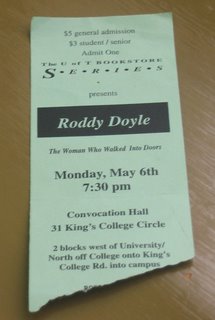
Having read Roddy Doyle's Barrytown trilogy (The Snapper, The Van and The Commitments) and of course Paddy Clarke, Ha Ha Ha, I got us tickets to hear Doyle at Convocation Hall in Toronto. Colin was the only person I knew in Toronto who would willingly accompany me to readings. Doyle read from The Woman Who Walked Into Doors. We were both impressed by his unassuming manner and his matter of fact transformation from rather ordinary teacher of geography to amazing novelist - Doyle gave us both hope.

Colin was an inveterate writer of letters to the editor, and of opinion pieces for the back page of The Globe and Mail's front section, the same page on which the Social Studies column appears. He often emailed me the links to his pieces when they appeared and the last one he sent was about the absurdity of bridge becoming a potential Olympic sport - we were in absolute agreement that one must distinguish between a game and a sport. One of these essays resulted from an encounter he and Gabby had had in the park near the house he’d bought in the east end of Toronto. Gabby had had to go to obedience school because she was just too fond of joggers in the park – she would leap on them with her muddy paws and Colin realized this just wasn’t appropriate behaviour. When he called me to tell me she’d graduated, he made a point of saying that she was the smartest dog in the class – and there was not a trace of self mockery in his voice when he said this. I had to stifle a giggle – he was dead serious and there was no reason for me to believe it was merely a proud human companion talking and that his conclusion regarding her brilliance wasn’t objective. Gabby’s behaviour may have been modified, but her general friendliness wasn’t, and one of the people they encountered turned out to be none other than one of Colin’s heroes, the brilliant Canadian actor, playwright, and novelist Ann-Marie Macdonald. He didn’t realize who she was until after they’d talked in the park, and he wrote a charming essay about their encounter for The Globe and Mail.

It was very strange to read one of Colin's letters to the editor about circumcision on the net after reading of his death. It was one of the ones he hadn't shared with me. It was very 'him' - iconoclastic, witty, well reasoned, and strongly worded. Here's a taste of his style: “...to assert that to have the procedure done is tantamount to torture is just plain offensive. Jews have been circumcising their male children for thousands of years. And believe it or not, we’re not all physically, sexually and psychologically scarred because of it.”

I am glad, after Colin told me Jewish people feel very much at loose ends on Christmas Day and tend to stay home eating cold pizza, that I started inviting him to my low-key Christmas celebrations. He was only able to make it once. I made a kugel for him, the first one I'd ever made, and he was suitably gratified by the pantheistic culinary effort. The following year he was in Florida visiting his grandparents, and then I myself left Toronto. I am also glad that I once hugged him really really hard, almost sending him through the plate glass window of a bookstore. More than anything else, I am glad that the last time I saw him I had nothing but good things to say to him about the new course he'd crafted for his life. I just had no idea it would kill him, and so soon.

In the last few years of his life, Colin was writing mostly prose rather than drama, and the last story he sent me was about a woman who habitually left the keys to her house in the door. The tension between her husband and herself was delicately depicted, centring around her absent-mindedness and its implications for their relationship. Like Jordan Baker in The Great Gatsby, she was careless in a way that her husband worried would cause harm to others. As it turned out, she herself was murdered as a result of leaving her keys in the lock. It's hard, in hindsight, not to view the bleakness present in this work as foreshadowing of his own untimely death.

Colin Stuart Krivy
February 23, 1967 to July 11, 2004

Rest in peace, Coli-baba.

Friday, July 07, 2006

Sailors and Business Girls


Copyright Ruth Seeley

I spotted this altered sign in a little studio/storefront on Yew Street in Vancouver's Kitsilano. It attracted a fair bit of attention on flickr (more so than most of my other photos), and I'm at a loss to understand its appeal, frankly.

It's not that great a photo, and the sign, when you look at it closely, has been altered. I've been struggling to figure out what it used to say - looks to me like 'business' has been altered from 'whores' - but then it doesn't look like 'girls' has been added. 'Working Girls' wouldn't have fit (since the 'e' is obviously part of the original signage.

Anyway, here it is. I'll go back and try to track down the sign's owner to see what s/he knows about its origins. And for the record, I'm a fourth generation 'working girl' - and none of us has been a member of the world's oldest profession.

Thursday, June 29, 2006

Aging


Caged Pinks.JPG


Copyright Ruth Seeley


"Growing old," observed British novelist Anthony Powell, “is like being increasingly penalized for a crime you didn't commit.”

Saturday, June 24, 2006

Updike in defense of the tangible book

The New York Times Sunday Book Review, which arrives in my email box late every Saturday night, features this week a charming and passionate essay by John Updike called 'The End of Authorship' that refutes Kevin Kelly's contention in The New York Times Magazine of May 14, 2006, that the world will be a better and more democratic place when books go the way of music and are customizable as music now is, when readers will be able to select snippets of novels and create their own anthologies just as they can now create their own playlists for their iPods. The Updike essay appeared June 25, 2006. 

Authors will, says Kelly, make money for their appearances, from workshops, and from interfacing directly with their readers. Updike points out that he rarely encountered one of his readers in the first 10 or 15 years after his work started being published. He also waxes eloquent on the joy of visiting bookstores, although not as eloquently as I could wax. Or perhaps, just as eloquently but in a different way.

The tactile experience of reading is not to be dismissed. Although I probably wouldn't have had the patience to slit the pages of a book two by two, I can certainly understand, given the weight and quality of the paper on which those books were printed and bound in their signatures, that for those a little less impatient than me, there was a ceremonial aspect to sitting at a lovely solid wood desk and carefully slicing along the folded edge with a utensil dedicated for this purpose. As one of my 18th and 19th Century lit profs said, in the days before television, reading was considered entertainment for the literate masses, and those who had the leisure to read at all were not daunted by the prospect of a long novel - they were, rather, delighted by the prospect of one that would occupy their leisure time for many days to come.

A real book is also portable, and while it's not difficult to imagine that technology will soon devise tiny perfect little optical readers that can be grabbed on the way out the door just like a book, they will NOT be just like books. Having worked in more than one bookstore on more than one occasion, I can tell you that for those who are passionate about reading, every shipment is like Christmas. In fact, the last time I worked in a bookstore I was forbidden to go anywhere near the shipments unless I was prepared to actually receive and shelve the books, since I'd fallen into the bad habit of opening all the totes, exclaiming with joy, and leaving a huge mess behind me. The design factor is not to be discounted in the book publishing industry - and frankly, web design has a long way to go before it can catch up with the sophistication of the book and magazine industries design capabilities (mainly because just about anyone can get some sort of web site up and going these days, regardless of their lack of comprehension of typography, graphic elements, and what constitutes good design, coupled with a blissful ignorance of its basic premise, The Golden Rule). I have seen books without even a title on their front covers fly off the shelves - there was a series of naughty books by a guy called John Colleton in the 70s that regularly disappeared in moments after being shelved based on their covers alone.

The prospect of reading even more megapixels isn't an appealing one. Even the experience of buying books online, convenient though it is, isn't as much fun as browsing in a bookstore. Nor am I anywhere near as likely to buy a book by an unknown author online, no matter how good its reviews. I certainly can't imagine buying a dozen or more books by authors unknown to me online. And yet I had no hesitation whatsoever to scoop up at least two dozen in the Virago women's writers series when they were on sale at David Mirvish Books in Toronto a decade or two ago. The covers, the chance to glance at the first paragraph, the fact that they were all on sale for less than half price - I was sold in no time. And I read every one of them too. The online book buying experience has really only one consolation for me - I have usually forgotten that I've placed an order by the time the books arrive, and thus conclude it's either my birthday or Christmas when they do magically appear. That's the point at which I get a little bit of the same excitement I get by fondling and poring over them in an actual store, accepting or rejecting them based on their covers, their first paragraphs, the back jacket blurb - and the amount of show-through in the paper on which they're printed. Buying online will also never give the joy of that spontaneous exchange of information called a conversation, either - the sort of conversation that often happens in the retail outlet when the person you're paying for the book has read it him- or herself - or the person in the line behind you spots it over your shoulder and tells you how much you're going to enjoy it. These conversations can take place wherever you go with your actual, real, live, fondle-able, tearable, write-in-able book, when someone sees you carrying it and you're suddenly embarked - often in the most unlikely places - on an oral ramble through the merits of the latest Peter Carey, My Life as a Fake, versus his earlier work, like Oscar and Lucinda or even - gasp - The Illywhacker.

It's a peculiar form of intellectual democracy when you feel you are constrained from speaking to someone because their ears are plugged with little headsets. What will happen when we can no longer make eye contact with our fellow public transit users because their eyes are also engaged in reading the text (downloaded from the internet and custom-selected by them) that's scrolling past (speed adjustable of course)?

"The printed, bound and paid-for book was — still is, for the moment — more exacting, more demanding [than information posted on the internet], of its producer and consumer both. It is the site of an encounter, in silence, of two minds, one following in the other's steps but invited to imagine, to argue, to concur on a level of reflection beyond that of personal encounter, with all its merely social conventions, its merciful padding of blather and mutual forgiveness. Book readers and writers are approaching the condition of holdouts, surly hermits who refuse to come out and play in the electronic sunshine of the post-Gutenberg village," says Updike. It's precisely because I want to read a book in the sunshine that I won't be giving up buying books anytime soon.

Things I wish I'd said


Reflected in the tuba's bell
Copyright Ruth Seeley


To use a camera as a means of artistic expression, a certain quality of spirit must be brought to aid light and air. Bayard Wootten, 1926 http://www.lib.unc.edu/ncc/pcoll/wootten/index.html

What is love? It is passion, admiration and respect. If you have two, you have enough. If you have all three, you don't have to die to go to heaven. William Wharton

The truly fearless think of themselves as normal. Margaret Atwood

To wear your heart on your sleeve isn’t a very good plan; you should wear it inside, where it functions best. Margaret Thatcher

Never doubt that a small group of thoughtful, committed citizens can change the world. Indeed, it is the only thing that ever has. Margaret Mead

Truth isn’t always beauty, but the hunger for it is. Nadine Gordimer

I don’t want to be a passenger in my own life. Diane Ackerman

Trust is the key element in generating social capital. Paul Dickenson

[A] company’s brand image is made up of two things: What they do inside and how they communicate themselves outside. If these two become one it becomes a very strong brand. Jamie Anley, Jam Design
http://www.jamdesign.co.uk/

Monday, June 19, 2006

Commercial Drive Festival


I took almost 400 photos at the Commercial Drive Festival yesterday, an annual car-free event held in the city's east end. I was a little nervous about doing event photography, because crowds aren't my thing. I'd love to go to the big national exhibitions like the CNE and the PNE, because I love the rides. But I can't take the crowds, I start to feel quite panicky. I've always regretted not making it back to the fair in Goderich, Ontario, that had all the rides and none of the crowds. Cheap thrills.

Much to my surprise, despite an estimated crowd of 50,000 over the course of the day, the Commercial Drive Festival was a joy to attend. The photographic themes we were trying to capture were Father's Day, community, and what a car-free street looks like. Most of the photos I took were of the children's bike-decorating event, and it was lovely to see fathers and sons, fathers and daughters, working to get those bikes decorated in time for the parade behind the marching band that picked them up in the park and led them to the main street of the festival (Commercial Drive). Not one of the people I asked permission to photograph refused me (and I was very conscientious about asking). Of course, this meant there was a certain amount of posing going on, but I was also able to get some great candid shots. This little girl insisted that her fuzzy toy was going to be the one riding the bike. I guess it's her current favourite. And this is one of my favourites from the almost 400 shots. Five of my photos have been used on www.nowpublic.com already - must keep uploading, must keep uploading.


Friday, June 16, 2006

Disappointing

This week I finally got it together to see a photo exhibit I'd heard about on CBC Radio, Alex Waterhouse-Hayward's Secret Gardens: Vancouver's Hidden Rooftops (show runs till June 24 at the Pendulum Gallery in the HSBC Building at 885 West Georgia @ Hornby streets in Vancouver www.pendulumgallery.bc.ca/current.html).

The photos are amazing, but I was so very disappointed to see that they weren't actually prints on display. Instead, the format was similar to display panels I've had created for community and stakeholder communication events (open houses, town halls). Printed on paper that didn't do the photos justice and surrounded by an incredible amount of text that won the war in terms of distracting the viewer, I'm left frustrated. These are beautiful photos, and I want to see some decent prints of them. I'll read the catalogue later, thank you very much.

For some web images of his work: www.alexwaterhousehayward.com/index.php.

The Mermaid and The Fisherman


Copyright Ruth Seeley

On a brief trip to Granville Island today I noticed the life-size statues of a mermaid and a ship's captain outside a store called The Walrus and The Carpenter. This is a proud, lovely, and successful mermaid. The accompanying statue of the captain shows him holding the tiller but otherwise empty handed - distracted, no doubt, by the enigmatic smile he'd received from the mermaid.

Thursday, June 15, 2006

Stalking the wild rosehip

Copyright Ruth Seeley

In the winter of 2005-6 I got more and more frustrated at not being able to find rosehips to photograph - I was viewing all these amazing macro images of rosehips from my flickr friends in the UK, and all I was finding was tiny little haws. The elegance of the rosehip's elongated oval shape and its wispy tails were essential - or 'primordial' as my Francophone friend Eric would say. Finally, after more than two weeks of wet shoes, slogging through the rain and peering at bushes, I headed for the library and took a different route. Wouldn't you know it, no more than a block from my house I found a bush just bursting with rosehips.